Solutions Page#
Problem 1 - Sator Square#
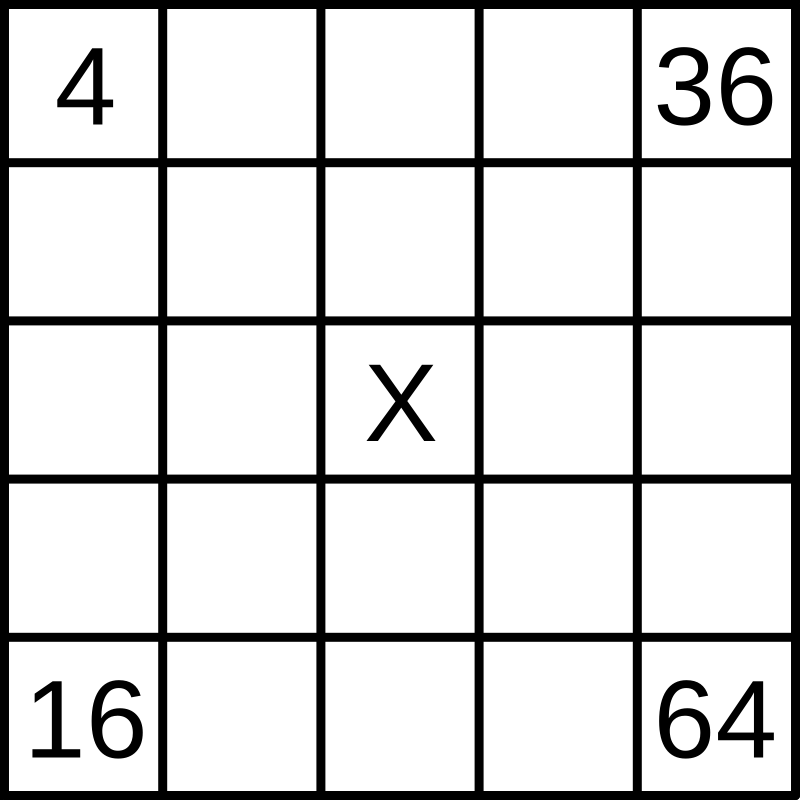
An arithmetic sequence is a sequence in which each term after the first is obtained by adding a constant to the previous term. For example, \(2,5,8,11,14\) is an arithmetic sequence with five terms, in which the first term is \(2\) and the constant added is \(3\). Each row and each column in this \(5\times5\) array is an arithmetic sequence with five terms. The square in the center is labelled \(X\) as shown. What is the value of \(X\)?
Hints#
Hint 1
How would define an arithmetic series' and its terms? Can you use that to solve for a specific term?Hint 2
$$ a_n=a_1+(n-1)d \implies a_5=a_1+(5-1)d\implies \left(\frac {16-4}4\right )=d \implies a_3=4+(3-1)3 \implies a_3=10 $$ Use this thinking twice more to find \(X\)Problem 2 - Triangular Thinking#
Two equilateral triangles are contained in square whose side length is \(2\sqrt 3\). The bases of these triangles are the opposite side of the square, and their intersection is a rhombus. What is the area of the rhombus?
Hints#
Hint 1
The formula for the area of a 30-60-90 triangle (side lengths of: \(\frac c2\), \(\frac c2 \sqrt 3\), \(c\)) from its hypotenuse length is \(\frac 18 c^2 \sqrt 3\)Hint 2
If there is a line that goes through the two intersection points of the equilateral triangles, the length of the segment of the line is \(2\sqrt 3\). The triangle that spans the outside of the equilateral triangle and the line is a 30-60-90 triangle. With that you can find the width of the rhombus in the middle, which is made of 2 equilateral triangles / 4 30-60-90 triangles.Problem 3 - No logs among thieves#
What is the product of all real numbers \(x\) such that the distance on the number line between \(\log_{2026} (x)\) and \(\log_{2026} (20)\) is \(26\) times the distance on the number line between \(\log_{2026} (\sqrt[26]{2026})\) and \(0\)?
Hints#
Hint 1
Remember your log rules. What is \(\log(b^a)\)? What is \(\log(\frac ba)\)?Hint 2
There are two cases, one where \(x\) is below \(\log_{2026} (20)\), and one where \(x\) is above \(\log_{2026} (20)\). You can enclose these both by putting the side to be solved in absolute values. This leads to case cancelling part of the other side. Look at log rules if you need any more help.Problem 4 - Logs of Hammurabi#
Positive real numbers \(b \neq 1\) and \(n\) satisfy the equations
$$ \sqrt{\log_b n} = \log_b \sqrt{n} \qquad \text{and} \qquad b \cdot \log_b n = \log_b (bn). $$The value of \(n\) is \(\frac{j}{k}\), where \(j\) and \(k\) are relatively prime positive integers. Find \(j+k\).
Hints#
Hint 1
Using simple log rules you can convert the two equations to: $$ \sqrt{\log_b n}=\frac 12 \log_b n \qquad \text{and} \qquad b\cdot\log_b n = \log_b (n) + 1 $$Hint 2
Substitute \(x\) as \(\log_b n\) into the simplified found in hint 1. Then solve, and substitute \(\log_b n\) back for \(x\)Problem 5 - Cost of a Product#
Consider the polynomial
$$ P(x)=\prod_{k=0}^{10}(x^{2^k}+2^k)=(x+1)(x^2+2)(x^4+4)\cdots (x^{1024}+1024) $$The coefficient of \(x^{2026}\) is equal to \(2^a\). What is \(a\)?